
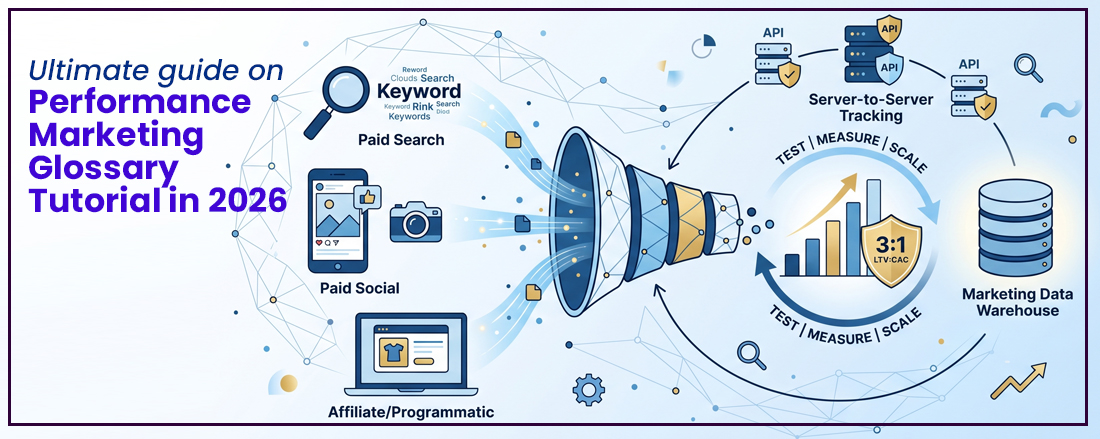
“Mastering Performance Marketing: The Ultimate Guide in 2026” by Web & SEO Training Institute
A Guide to Data-Driven Growth, Strategic Attribution, and Modern MarTech Systems
Performance marketing is the intentional blend of data engineering, financial planning, and multi-channel media buying. Unlike traditional brand advertising that focuses on unmeasured awareness, performance marketing operates on a clear rule: ad budgets are spent only when they achieve verifiable user actions, such as sign-ups, leads, or completed checkouts.
Download FREE Ultimate Guide in Performance Marketing in 2026
To successfully scale a digital brand today, growth teams must master three foundational strategies:
- Hybrid Tracking Systems: Combining browser tracking with server-side data collection to maintain complete accuracy.
- Unit Economic Modeling: Calculating exact financial boundaries to prevent unprofitable ad spend.
- Cross-Channel Testing: Experimenting across various ad platforms to find the lowest acquisition costs.
Multi-Channel Media Matrix
Different advertising networks attract different user behaviors. Managing a healthy marketing mix requires understanding how each channel functions and where its data tracking might fall short.
1. Paid Search (SEM)
- Auction Mechanism: Real-time bidding on keywords tied directly to user searches.
- User Mindset: High Active Intent; users are looking for immediate answers or specific products.
- Tracking Vulnerability: Often claims too much credit under Last-Touch models and can inflate results by bidding on your own brand name.
2. Paid Social
- Auction Mechanism: Visual optimization based on how users interact with images and video assets.
- User Mindset: Passive Discovery; browsing casually where demand is sparked by engaging creative “hooks”.
- Tracking Vulnerability: Relies heavily on view-based credit tracking and is deeply impacted by mobile privacy opt-outs.
3. Programmatic Display & Native
- Auction Mechanism: Real-time automated bidding across global website ad spots.
- User Mindset: Passive Scanning; reading content online while viewing ads on the periphery.
- Tracking Vulnerability: High rates of unviewed banner ads and requires constant checks against invalid click traffic.
4. Affiliate Networks
- Auction Mechanism: Payouts based entirely on actions, triggered only when a sale is verified.
- User Mindset: Transactional Validation; looking for final reviews, product comparisons, or promo codes.
- Tracking Vulnerability: Late-stage coupon codes can steal credit from the top-of-funnel channels that introduced the customer.
Marketing Glossary & Strategic Frameworks
Understanding standard industry terms ensures data analysis remains accurate across your entire marketing stack.
Testing & Funnel Tactics
- A/B Testing Sandbox: An isolated test space where creative or bidding updates are compared against a control version. This keeps budgets safe from underperforming variations.
- Acquisition Funnel: The step-by-step journey (Awareness, Interest, Desire, Action) a user takes to convert. Mapping this highlights path drops where fixes are needed.
- Assisted Conversions: Marketing touchpoints that introduce or nurture a buyer without being the final click. Tracking this stops teams from cutting early-stage channels that feed the funnel.
Attribution & Tracking Models
- Algorithmic & Data-Driven Attribution: Using machine learning to analyze unique path histories and distribute conversion credit accurately. This removes blind spots and identifies the value of early brand ads.
- Deduplication Logic: Backend controls that clean up data to ensure a single purchase isn’t counted multiple times across different ad networks. This prevents overpaying affiliate fees.
- First-Click vs. Last-Click Bias: First-click gives all credit to the initial ad , while last-click over-credits the final link. Balancing these stops teams from misallocating budgets.
Data Infrastructure Terms
- Data Clean Rooms: Secure, encrypted analytic spaces where separate brands can match customer tables without exposing private user details. This circumvents cookieless tracking limits.
- Server-to-Server Tracking (S2S): Passing purchase records directly from your database server to the ad platform API. This bypasses browser ad blockers and secures clean optimization data.
- Marketing Data Warehouse: A central storage hub (like BigQuery or Snowflake) that holds raw marketing metrics. This unifies data streams for deeper, custom channel analysis.
Advanced Financial Engineering
Scaling digital ad accounts based only on standard channel dashboards can create severe cash flow strain. Sustainable growth relies on managing three core mathematical formulas:
1. Customer Lifetime Value to Cost Ratio (LTV:CAC)
The primary benchmark for overall company health. It verifies whether the long-term margin profit earned from a customer safely outpaces the upfront cost of acquiring them. Ratios above 3:1 point to a healthy, scalable business model.
Formula: LTV:CAC = Long-Term Gross Margin Contribution Per Customer / Total Customer Acquisition Cost (CAC)
2. Incremental Return on Ad Spend (iROAS)
Tracks the precise revenue efficiency of adding more budget to an active campaign. It tells you if your next dollar spent is driving net cash or simply hitting diminishing returns in the ad auction.
Formula: iROAS = (Revenue in Test Window – Revenue in Baseline Window) / (Spend in Test Window – Spend in Baseline Window)
3. Media Efficiency Ratio (MER)
The ultimate holistic marketing metric. By dividing total website revenue by total cross-channel ad spend, you strip away double-counted conversions on ad networks and track real business growth.
Formula: MER = Total Gross Business Revenue / Combined Cross-Channel Media Spend
Modern MarTech Architecture
As standard web cookies are phased out across internet browsers, modern marketing infrastructure must rely on server-side engineering across three core layers:
- The Data Activation Layer (CDPs): Customer Data Platforms aggregate raw customer information, app milestones, and purchase data from separate silos into clean first-party master profiles. This supplies high-quality match lists to ad networks without depending on browser-level trackers.
- The Edge Collection Layer (Server-Side Tagging): This moves the data tracking process off the user’s device onto a secure cloud server that you own. When a sale occurs, the data hits your server first—where it is cleaned and normalized—before being securely handed over directly to ad network APIs. This guarantees reporting precision and avoids browser script blocks.
- Privacy-Safe Identity Resolution: Using secure Data Clean Rooms allows partners to run targeted co-marketing campaigns and trace multi-channel user paths safely within modern privacy boundaries.
Actionable Corporate Roadmap
To transition from legacy tracking to a high-scale, modern growth framework, execution should follow three distinct phases:
Phase 1: Deep Infrastructure Optimization
Move away from standard browser tracking pixels immediately. Set up direct server-to-server API connections (such as Meta Conversions API and Google Enhanced Conversions) across your web domains. Routinely audit your Event Match Quality (EMQ) to ensure ad network optimization algorithms are receiving dense, high-fidelity data feeds.
Phase 2: Establish a Testing Sandbox
Dedicate a fixed portion of your monthly marketing budget strictly for experimentation on secondary networks like Programmatic Native or Affiliate tracks. Use isolated control groups to run Incrementality Lift Models, proving if your paid ads are capturing new sales or simply claiming credit for organic traffic.
Phase 3: Automated Financial Safeguards
Connect your active campaign budgets directly to back-end unit economic goals. Set up automated rules in your ad accounts to pause campaigns instantly if your incremental acquisition costs exceed break-even thresholds. Monitor your macro Media Efficiency Ratio (MER) daily to guide budget shifts and focus strategies on net business profit.
Quarterly Operations Note: Complete an end-to-end data and multi-channel audit every 90 days. Ad network rules and platform environments shift constantly, but maintaining strong server-side data, strict incrementality checks, and firm unit economic guardrails guarantees predictable, long-term enterprise scale.
Disclaimer: This blog and all its contents are protected by copyright, owned entirely by Web &SEO Training Institute Kolkata (Academy of Web Technologies & Information Management – AWTIM). We strictly prohibit the use, duplication, or transmission of any text, screenshots, or featured imagery for commercial or non-commercial purposes without obtaining direct, written permission from an authorized representative of our company. Legal action will be taken against any unauthorized use.
Read Also:
- Performance Marketing Course in Kolkata: How It Works, Advantages, Syllabus, Skills, Duration, and Fees in 2026
- Digital Marketing Course in Kolkata 2025: Syllabus, Fees, Duration, Jobs, Freelancing
- The Scope of Digital Marketing Career in Kolkata (2026): A Complete Guide to Jobs, Salary & Future AI Trends
- How to Choose the Right SEO Training Institute in Kolkata for the Best SEO Course
- Boost Your Local Biz: A Simple Guide to Using Schema for SEO Wins
- Benefits of taking a digital marketing course in 2025?